The conservation experiment giving the rare Handfish a fighting chance
The Foundation for Australia's Most Endangered Species (FAME) preventing the extinction of Australia's most endangered species.
With fewer than 250 Red Handfish estimated to remain in the wild, saving the species required more than good science. It required funding to back an ambitious idea. That is where FAME stepped in.
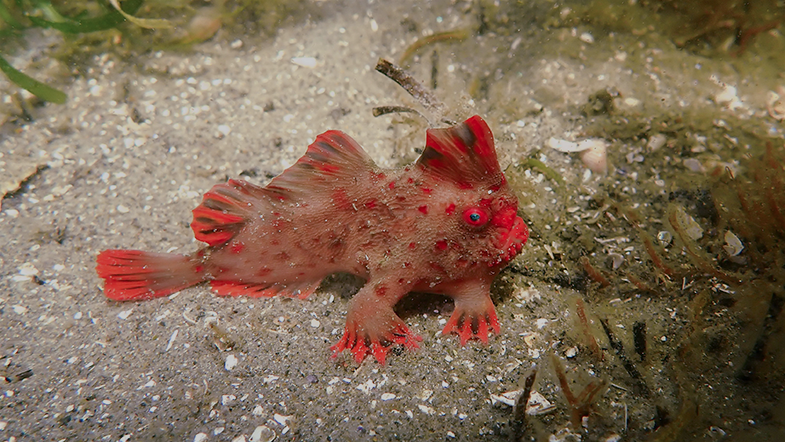
The endangered Red Handfish is a spectacular animal that looks like it’s from another world. Radiating an intense red colour, the small fish has fins resembling a set of tiny human hands. These hands aren’t just its namesake, they help it walk across the seafloor.
As one of Australia’s rarest fish, the Red Handfish certainly stands out. But the brilliant animal is also struggling for survival in small patches of reef and seagrass across Tasmania’s Frederick Henry Bay, where fewer than 250 are estimated to remain in the wild.
“Habitat degradation, human disturbance and climate change all threaten the isolated populations,” says Tracy McNamara, CEO of Foundation for Australia’s Most Endangered Species (FAME).
Back in 2023, the fish population was so critically low that researchers at the University of Tasmania’s Institute for Marine and Antarctic Studies (IMAS) developed a plan to breed the fish in captivity, restore habitat and return fish to the wild. However, turning that plan into a dedicated conservation program required funding.
That’s where FAME, a non-profit dedicated to funding science-based conservation projects, stepped in. “We go where no one else goes, and are prepared to take a risk,” Tracy says. “We said to the researchers: ‘tell us your dream. Tell us what you really need to make a difference to the survival of the Red Handfish’.”
In 2023, FAME committed more than $1 million over four years to IMAS and its partners to create a multi-teared project that included a world-first Handfish school, designed to prepare young fish for rewilding. Then in 2024, a three-year Equity Trustees Animals Pillar grant, contributed $150,000 to FAME to fund the Handfish school.
Tracy says the idea behind the funded school is to start simple and develop as the fish grow. “First, the fish are provided with artificial seaweed in their tanks. Then, as they grow, we introduce more elements that fish would encounter in their natural environment like invertebrates and water movement. By the time the fish move to a more natural environment than a tank, they are ready for the wild.”
Over its first three years, the Handfish school has resulted in more than 450 hatchlings. In October 2025, 65 captive-raised fish were rewilded, with another release planned. In total, the number of surviving Red Handfish in captivity has near tripled.
“We said to the researchers: ‘tell us your dream. Tell us what you really need to make a difference to the survival of the Red Handfish’..”
From one fish to a wider conservation model
The project also aims to restore the habitat the fish depend upon with seagrass planting, kelp restoration. Efforts are also being made to the sea urchins that eat the seaweed, which is so essential to the survival of the Red Handfish. “To save one fish, you need to build an ecosystem,” Tracy explains. “This is an additional benefit to the project.”
The Handfish School is also producing knowledge that can be used beyond Tasmania. The process and challenges are being documented so that PhD students involved in the project can use the experience in their future work.
“The documented concepts and challenges of the project can all be used by various conservation organisations around the world to learn from. It can even be picked up by a zoo looking to rewild animals.”
Tracy adds that the project also demonstrates what can happen when conservation action comes early enough to change an endangered species’ trajectory. “If we had waited to act to save the Red Handfish, then in a few years’ time it may have been too late. But by acting when we did, we started to make a difference to the population.
“With funding, we can give conservation projects like this the time and space to change what is possible for a species.”
Find out more Equity Trustees Philanthropy services
Find out more The Foundation for Australia’s Most Endangered Species (FAME).
Red Handfish in the wild. Credit: Jemina Stuart-Smith.