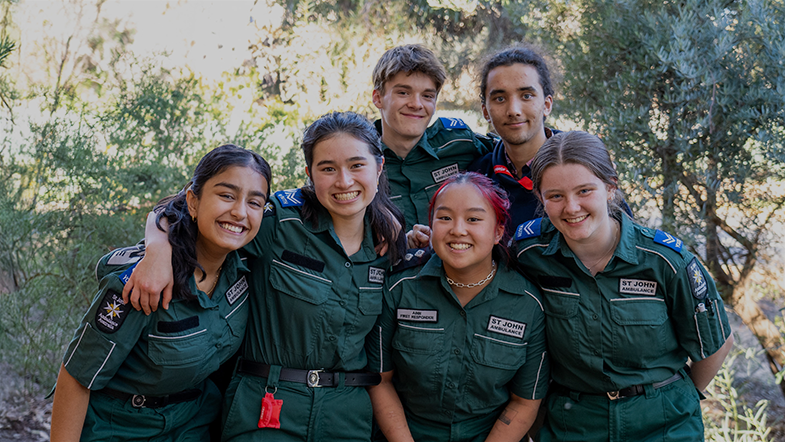
Could these young people save your life? St John Ambulance thinks so
This youth program is giving young people more than first aid skills. It is helping them to find belonging, build confidence, serve their community, and open doors to new opportunities.
At an age when many young people are still figuring out where they fit in the world, St John Ambulance (St John) gives them something rare: a sense of belonging and purpose, and the chance to save lives.
Nicole joined St John’s youth program in year eight expecting a fun extracurricular activity and a chance to learn first aid. “Little did I know that it would become so much more than that, and eventually become such a big part of my life,” she says.
St John’s Youth Program combines first aid, leadership and community service for young people aged eight to 17. Young people learn how to respond to injury and illness by practising first aid in realistic scenarios, and then volunteer in their community, applying the skills they have learnt. Members can also train as youth leaders from age 18 to 25, and go on to run the program themselves. It’s a unique opportunity for genuine leadership and responsibility. Many young people also continue to volunteer with St John as adults.
“St John doesn’t bring people together because they live in the same place or come from the same background, it brings people together because they are willing to turn up, and give their time to be there for other people,” Nicole says.
That instinct to show up for others is now shaping what Nicole wants to do with her own life. She hopes to study medicine, and eventually work in medical retrieval.
“Before joining, medicine wasn’t a career I saw myself pursuing at all. But through St John, being someone who is prepared to help in a medical emergency became an important part of my sense of self.”
Nicole’s experience is the kind of change St John hopes to make possible for thousands more young people. Today, just under 2,500 young people take part across almost 100 divisions nationwide.
“We know what to do. It’s an incredibly powerful program. Now we just need to reach more young people.”
The program’s impact extends beyond knowing what to do in an emergency. Anita Truninger, General Manager Engagement at St John NSW, adds that young people gain confidence, self-esteem, purpose and a sense of belonging through the program.
“It’s about empowering young people so they know they can actually have some agency in their life,” Anita says. “They can contribute and serve their community.”
That opportunity is increasingly in demand. NSW currently has waitlists for young people wanting to join, while St John has set a national goal of reaching 5,000 participants by 2029, with regional communities a particular focus.
Reaching them requires more than opening another division. Funding is needed to train volunteer leaders, provide medical equipment, uniforms, offer camps and accredited leadership programs, and maintain youth voice and child safety at the highest level. “Per child, the investment is significant, and we try to make the program available to everyone regardless of their circumstances,” Anita says.
Philanthropic support, managed by Equity Trustees, can help the organisation meet demand and extend the program to more young people, particularly in communities where opportunities can be limited.
Fairlie Tucker, National Director of Partnerships, Fundraising and Community Impact at St John Ambulance Australia explains that investment now can give more young people skills and confidence that continue to shape their lives well beyond their time in the program.
“Financial support will go a long way,” says Fairlie. “There’s a lot of evidence to prove that this program works.
“We know what to do. It’s an incredibly powerful program. Now we just need to reach more young people. With that support, we can transform more lives and open doors for young people.”
Photo credit: Charlie Bartak. St John Ambulance Australia.