Here’s how Ear Foundation Australia is helping kids to hear, learn and thrive
How the Ear Foundation Australia is improving hearing health outcomes in the Pilbara communities
An invisible hearing condition can leave children struggling in the classroom while families and teachers remain unaware. Ear Foundation Australia’s outreach program in the Pilbara is helping change that, one community at a time.
In Western Australia’s Pilbara, hundreds of children are struggling to hear what’s being taught in the classroom because of an invisible condition that affects their learning. Despite the gravity of the barrier getting in the way of their wellbeing and education, the health issue can easily go unnoticed by everyone around them. CEO and co-founder of the Ear Foundation Australia, Dr Lara Shur, explains that even families and teachers may not realise a child is struggling to hear.
“We have kids in class who are not able to hear due to a very preventable condition, and yet we still expect them to function well, listen, learn and thrive.”
The condition is middle ear disease, which can cause significant hearing loss. In Lara’s experience, it’s often seen starting early in life. “A baby with ear disease may cry because their ears hurt, but the connection between sore ears and hearing is not necessarily recognised. As the child grows, living with poor hearing can become normal.” By the time the child is aged two or three years old, and not talking as expected, the underlying hearing problem may still be missed. “The child may not even realise they have a hearing problem and nobody has put it all together.”
Ear Foundation Australia was established in 2013 by Lara and two other co-founders, bringing together three different areas of expertise: audiology and speech pathology, teaching and education, and nursing and audiometry. That combination is central to the organisation’s approach.
“Kids operate in education. Kids need to get well through a medical model. Kids need rehabilitation for their hearing issues through the allied health lens,” Lara says. “So the secret ingredient has been the combination of the different approaches.”
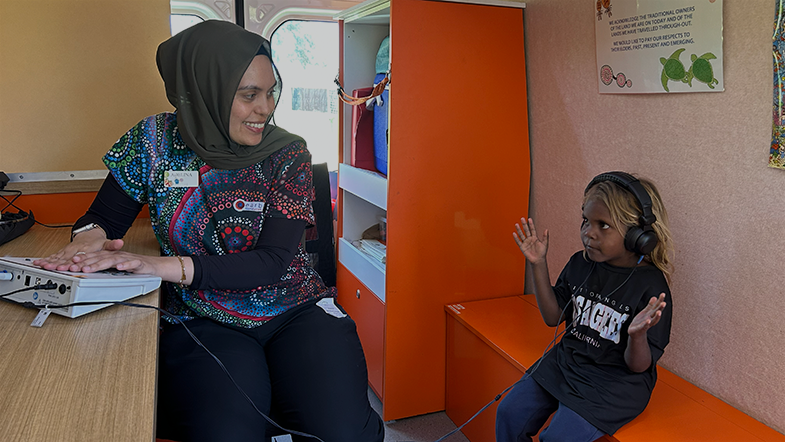
Today, Ear Foundation Australia runs several programs across Western Australia, including its Earbus outreach service. It has seen more than 100,000 children since it began, including just under 20,000 through outreach. In the Pilbara East, where Lara says some of the highest rates of ear disease in Australia are found, the outreach program has grown from six sites to 22.
“It turns out that when you keep them in the treatment pathway, and you come back month after month, children get well.”
The teams travel long distances to reach communities, then return regularly to check children’s ears and hearing, provide treatment and follow their progress. The service is designed to keep children moving through treatment rather than leaving families with a referral they may struggle to pursue.
The model brings health, medical, allied health and education together. A nurse can look in a child’s ears and identify a problem, an audiologist can test their hearing there and then, and a doctor or nurse practitioner can provide treatment. The audiologist can then speak directly with the classroom teacher about what the child can and cannot hear and what needs to happen next. Medication can also be dispensed to the family on the spot.
“So you don’t lose children in the clinical pathway,” Lara says. “It turns out that when you keep them in the treatment pathway, and you come back month after month, children get well.”
That continuity is now being supported by a new three-year, $55,000 grant from the Maria Vasas Foundation, managed by Equity Trustees, with the granting decision endorsed and supported by the co-trustee and advisory board. The funding is supporting Ear Foundation Australia’s outreach work in the Pilbara East, where around 2,500 to 3,000 children need regular checks and treatment. It helps bring specialist and medical staff into communities each month.
Consistency is critical. Children may move from one community to another, so the teams follow them and continue their care. Lara says that after nine to 18 months of regular visits, the organisation can see rates of ear disease and perforated eardrums fall sharply.
“This grant gives certainty to the visits,” Lara says. “Ultimately, this is not just about getting kids well. It’s about getting them well in school, and then allowing them to hear like everybody else can: to learn, to stay in school and to thrive.”
“Our Foundation is committed to supporting young people through education. By fostering cultural connection, self-worth and confidence, we help create pathways for them to realise their potential and thrive.” Maria Vasas Foundation.
Find out more about Maria Vasas Foundation, managed by Equity Trustees
Find out more about Equity Trustees Philanthropy and Grant Funding
Photo credit: Ear Foundation Australia