
Equity Trustees Monthly Market Summary September 2026
Market summary
September was a challenging month for Australian investors as rising bond yields; geopolitical tensions, persistent inflation concerns and softer commodity prices weighed on equity markets. The S&P/ASX 200 declined 2.4%, underperforming most major developed markets, while global markets remained focused on the prospect of interest rates staying higher for longer weighing on equity market sentiment. Bond markets experienced further weakness as yields moved sharply higher, while economic data both domestically and internationally continued to point to relatively resilient growth conditions despite restrictive monetary policy settings.
Equity market performance – Equity markets weakened as bond yields rose strongly.
- After rising for five consecutive months, the S&P/ASX 200 fell 2.4% during September, lagging major international markets including the US. Australian equities were weighed down by their larger exposure to resources and China-sensitive sectors.
- In USD terms international equities fell 1.1%, but in AUD terms international equities rose 1.85%. Tech related markets performed best (Korea, Taiwan, US Nasdaq, Japan). Globally, breadth was weak.
- Rising government bond yields pressured equity valuations globally.
- Value stocks outperformed growth stocks during the month as investors favoured companies with near-term earnings certainty and stronger cash flow profiles in a higher interest rate environment
ASX200 Sector performance – Healthcare continued its recent rebound
- Healthcare (+4.4%) was the strongest performing sector, led by strong gains from CSL, Ramsay Health Care and Ansell, supported by positive earnings outcomes and defensive investor positioning.
- Energy (+0.64%) was the only other positive sector, benefiting from higher crude oil prices and geopolitical tensions affecting global energy supply chains. Santos was among the strongest contributors.
- Information Technology (-10.61%) was the weakest performing sector impacted by higher bonds yields and AI disruption fears, with notable declines in Xero, WiseTech Global and NEXTDC.
- Materials was the largest detractor from overall index performance as weakness in iron ore, lithium and broader commodity markets weighed on major miners including BHP, PLS Group and IGO.
- Property securities (AREITs) fell as higher rates weighed. In Australia, transactions slowed and Goodman Group withdrew an application for a 90MW data Centre in Lane Cove. Globally REITs fell 3.3% with European REITs down 7.2% and Asian REITs also falling heavily.
- Globally, the best performing sectors were IT and Communication Services, whereas the worst performing sectors were Materials, Consumer discretionary, Real Estate and Financials. Five sectors in the US ended down more than 5.5%.
Bond markets – Investors priced in more restrictive US Federal Reserve
- Australian and global bond markets delivered negative returns as yields continued to rise amid persistent inflation concerns.
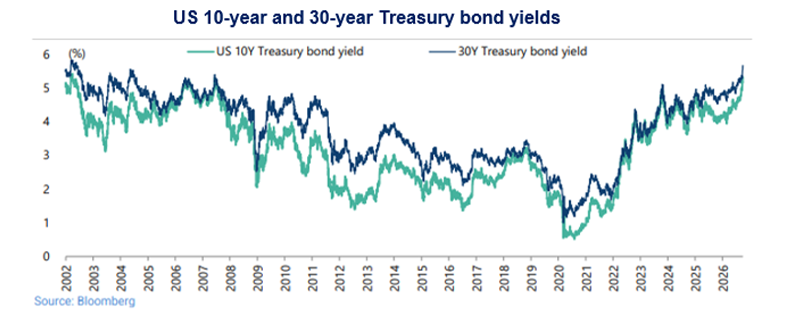
- The Australian 10-year Government Bond yield rose 25bps toward 5.3%, while US 10-year Treasury yields jumped 53bps to 5.28% reaching their highest levels of the year as markets priced in prolonged period of restrictive monetary policy.
- The Bloomberg AusBond Composite Index declined 0.9% as falling bond prices offset coupon income, producing negative returns for fixed income investors.
Rising real yields were a key driver of market performance during September, placing pressure on growth assets, listed property securities and longer-duration equities.
Australian economic news
- Australian GDP growth remained positive, demonstrating that domestic economic activity continues to show resilience despite higher borrowing costs.
- Employment growth remained robust during the month, although the unemployment rate edged higher, suggesting labour market conditions are gradually easing.
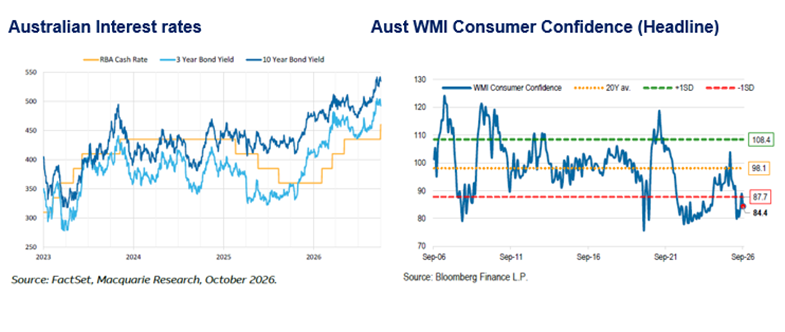
- The NAB business survey deteriorated, consumer confidence fell and house prices dropped further.
- The Reserve Bank of Australia increased the cash rate to 4.60%, maintaining a cautious stance toward inflation despite some moderation in recent inflation readings.
- The Australian dollar (-3.1% to 69.5c) weakened against the US dollar as higher US bond yields attracted capital flows and strengthened the greenback
Global economic news
- Global economic data remained relatively resilient, with business activity surveys continuing to indicate expansion despite tighter financial conditions.
- Investors increasingly embraced a "higher-for-longer" interest rate outlook as US economic growth and labour market data remained stronger than expected.
- The US Federal Reserve increased interest rates 25 to 3.75%-4%. The US dollar rose on the September rate hike, increased future rate hike expectations and robust economic growth.
- China continued to face economic headwinds, particularly within its property sector, contributing to weaker commodity demand expectations and volatility across Asian markets.
- Geopolitical tensions in the Middle East remained elevated, supporting energy prices and reinforcing concerns regarding global inflation and supply chain disruptions.
Commodity performance – Mostly negative excluding energy related commodities
- Iron ore prices declined approximately 7%, reflecting concerns surrounding Chinese steel production and ongoing weakness in the Chinese property market. Base metals and soft commodities also fell.
- Lithium prices continued to experience significant pressure, extending a prolonged downturn that negatively affected ASX-listed battery-material producers.
- Brent crude oil (+14.4%) rose strongly during the month, supported by geopolitical tensions and supply disruptions, making energy one of the best-performing commodity segments.
- Precious metals weakened, with gold (-6.3%) and silver (-9.2%) falling as rising real interest rates reduced investor demand for non-income-producing assets
Earnings revisions – Trending weaker locally
- Consensus FY27 and FY28 earnings forecasts for the ASX 200 continued to trend lower, highlighting increasing caution around the earnings outlook.
- Earnings growth in the US remains strong. The US market is absorbing higher rates through an earnings upgraded cycle.
- The ASX200 12-month forward dividend yield is 3.5%. Aggregate dividend growth in FY27F is currently forecast at 3.8%.
- The ASX200 is now trading on 17.1x 12-month forward price- earnings ratio – a small premium to historic levels. Earnings risk remains weighted to the downside which leaves us tactically cautious on Australian equities.
Outlook
Looking ahead, markets are likely to remain focused on a few key themes including the direction of global bond yields, the path of inflation, geopolitical tensions, continued AI capex and the strength of Chinese economic activity. While economic growth remains resilient in both Australia and the United States, earnings expectations have begun to soften and monetary policy remains restrictive. The upcoming AGM season in Australia may show that more restrictive financial settings are challenging trading conditions for domestic economy facing companies. Defensive sectors such as Healthcare and quality businesses remain relatively well positioned should economic conditions moderate further into 2027.
Find out more about Asset Management
DOWNLOAD FULL REPORT