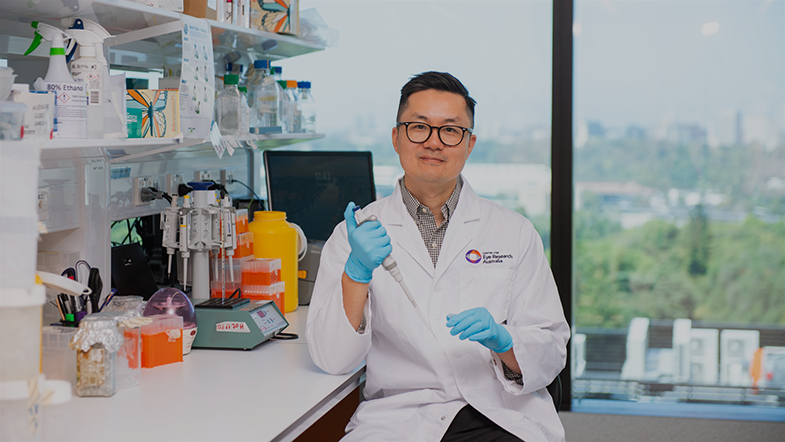
The Australian innovation that could reshape gene therapy
From an Australian laboratory to potential clinical trials, Dr Jiang-Hui (Sloan) Wang’s research is exploring new ways to deliver gene therapy to the eye.
Groundbreaking research at the Centre for Eye Research Australia (CERA) is working towards new ways to protect sight in people with inherited retinal diseases.
Dr Sloan Wang, Head of Ocular Genetic Therapeutics Research at CERA, is engineering next-generation viral vectors known as adeno-associated viruses (AAV) to improve how therapeutic genetic material is delivered to cells in the eye. "The current gene therapy products using these AAV vectors have limitations in how much genetic material they can deliver to cells," Dr Wang says. "That's why we're trying to engineer the next generation of AAV vectors, so we can deliver it more efficiently to the targeted cells."
A viral vector is a vehicle used to deliver therapeutic genetic material into a target cell. In gene therapy, a modified virus can carry a healthy copy of a gene into the cells where it is needed. A major challenge is getting that genetic material safely and efficiently into the right cells of the retina.
The stakes are high. Inherited retinal diseases can progressively damage the retina, causing deteriorating vision and, in many cases, blindness. Around 16,000 Australians are affected, with CERA describing inherited retinal diseases as the most common cause of blindness among working-age Australians.
"For most of patients with inherited retinal disease, there is no chance to get any sort of treatment or cure," Dr Wang says. "With this AAV-engineering technology, if it proves to be effective and safe, we have greater hope for those patients."
“With this technology, if it proves to be effective and safe, we have greater hope for people living with inherited retinal disease.”
Dr Wang's research is supported by a $350,000, two-year grant from the DHB Foundation, managed by Equity Trustees. The funding has helped to establish his independent research program at CERA after returning to Australia from the United States, where he trained in gene therapy.
The grant is also helping build Australia's capacity to engineer next-generation viral vectors locally. "This is the first time Australia has had the capacity to engineer and manufacture these AAV vectors," Dr Wang says.
"The engineered AAV I developed have been very successful and are superior compared with existing viral vectors," Dr Wang says. "We've also attracted a lot of interest from industry to further test these viral vectors."
The next stage could bring the research closer to patients. The vector is only one part of a future gene therapy, with an appropriate therapeutic gene also needed for a particular disease. "If everything comes together, and the technology proves safe and effective through further testing, I think we can start a Phase 1 clinical trial for a selected inherited retinal disease within five years."
Philanthropic funding is helping make that possibility achievable in Australia, supporting Dr Wang's research and the specialist infrastructure needed to develop and produce viral vectors locally.
"We've now established very close collaborations with our US partners, and this gives us a great opportunity to continue the research."
The potential goes beyond Dr Wang's own research program. CERA's emerging viral vector capability could support other gene therapy programs and researchers across Australia, helping build a stronger local pathway from laboratory discovery towards future treatments.
Dr Wang hopes that pathway will ultimately give people living with inherited retinal disease options they have never had before.
Find out more about Equity Trustees Philanthropy and Grant Funding
Photo credit: Centre for Eye Research Australia