
Equity Trustees Monthly Market Summary August 2026
Market summary
Equity markets mostly gained
- The ASX 200 rose for the fifth straight month (+1.54%). Global equities (MSCI World ex Aust) rose 2.58% in local currency terms and 0.53% in $A terms.
- The US equity market (S&P500) rose 2.7%. Strength was broad based. The tech laden Nasdaq rose 4%. Software companies kept rebounding and large cap tech performed strongly. Japan jumped 3.7%.
ASX200 Sector performance – Reporting season drove a wide dispersion of returns
- The best ASX200 performing sectors were Healthcare (+18.8% - driven by CSL’s 40% rise), Materials (+12.2%) and utilities (+7.4%). The Gold sector (+29%) rallied strongly. The worst performing sectors included Consumer discretionary (-7.9%), Real Estate (-6.7%) and Financials (-5.4%). Growth and Quality factors performed better in August after a challenging last 12 months. Small and mid-caps outperformed.
- Globally the best performing sectors were Materials, IT and Healthcare while Utilities and Real Estate lagged.
- Considering the market capitalization of ASX200 stocks, the top five contributors to the index were BHP (+99.3bps), CSL (+77.7bps), Evolution Mining (+24.2bps), Northern Star Resources (+16.7bps) and PLS Group (+12.6bps). The bottom five contributors were Commonwealth Bank (-97.4bps), Westpac (-37.5bps), Wesfarmers (-37.2bps), National Australia Bank (-27.3bps) and Goodman Group (-13.8bps). From a sector standpoint, performance was highly concentrated with Materials (302bps) and Healthcare (104bps) offsetting weakness from Financials (-184bps).
Bond markets sold off
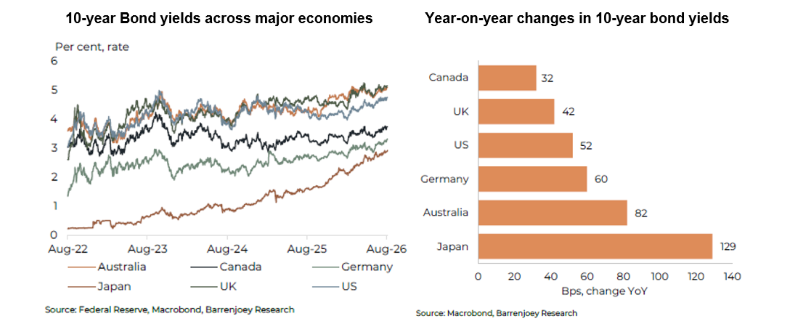
- The Australian bond market (Bloomberg Ausbond Comp 0+Y) fell 0.22%. The Australian 10-year bond yield rose 16.5bps to 5.09%. The US 10-year bond yield rose 1.5bps to 4.75%. US 30-year bond yields rose to 5.3% (a multi-decade high).Sticky inflation, resilient growth, rising interest rate expectations, competition from corporate debt (large AI related) issuance and US fiscal concerns saw global bond yields rise.Higher bond yields effectively tighten monetary conditions (eg higher mortgage rates, business borrowing costs rise).
Global economic news
- In the Middle East, there was little sign of diplomatic progress between Iran and the US despite the occasional hints of potential progress.
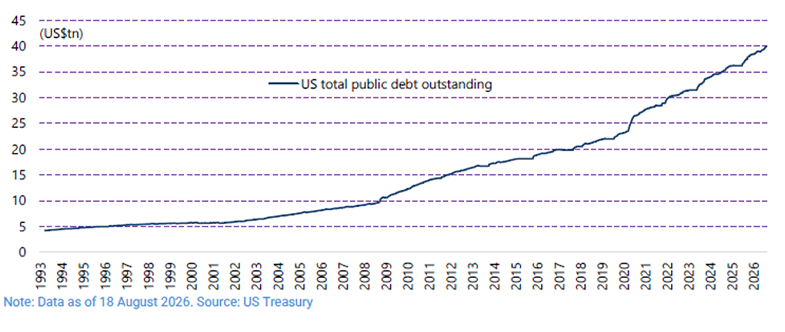
- US government debt crossed US$40 trillion. US inflation data was in line with expectations while labour market data, retail sales and consumer sentiment data was softer.
The US dollar sold off against most currencies.
- Expectations remained tilted toward a US rate hike in September. This was the stance based on futures pricing coming out of the July FOMC meeting and was reinforced by August's Fed speak. Fed chair Warsh's much-anticipated remarks at the Jackson Hole symposium also leaned hawkish, referencing "concerning" inflation numbers and arguing that recent softer inflation data may not reflect meaningful improvement in the underlying trends.
Australian economic news
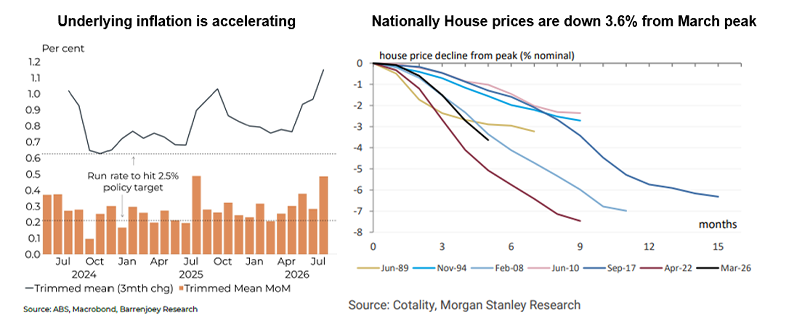
- The RBA held rates steady at 4.35% early in the month, but later in the month the July CPI showed inflation remaining more persistent than expected driven by domestic price pressures (see chart below). Markets moved to price in another rate hike by year end.
- House prices continue to fall and are broadening out. Prices fell 1.2% month-on-month in July and another 0.9% in August, extending the downturn to a fifth consecutive month. Further falls are likely given increased chances of another RBA rate rise this year.
- Despite weak sentiment, falling house prices and higher interest rates, consumer spending has remained more resilient than expected. The labour market data softened slightly but remained relatively firm. The $A rose 2.11%.
Commodities rose.
- Iron ore prices rose 5% (to US$100/t) while met coal prices surged 25% to US$269/t due to increasing safety inspections in China restricting production and forcing up domestic prices.
- Gold jumped 10% to US$4437/oz fuelled by concerns around the US fiscal position, surprise fall in US payrolls and the US Treasuries announcement to increase buybacks of US bonds to try to control the long end of the yield curve. Increased money supply, lower real rates and a lower USD all supported gold. Continued and broadening of central bank buying, ongoing geopolitical tension along with increased investor flows have also seen gold rally.
- Base metals were broadly stronger (+1-4%) as was oil +1.3%. Soft commodities rallied strongly also.
- Spodumene (Lithium) prices improved 17% supported by strong demand momentum, the delayed restarted of the CATL operations and consistent inventory draws.
ASX Earnings revisions remain negative and the market remains richly valued
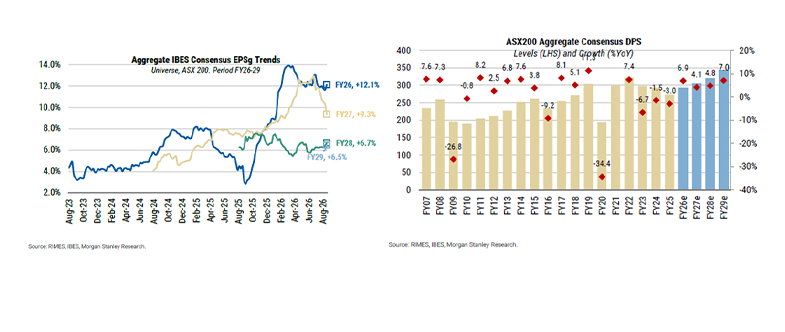
- Consensus revisions remained negative for the Australian market (-2%) during the month and have been negative over the last 3-4 months. FY27 earnings per share growth have moderated to +9.3% (from ~12% two months ago).
- The ASX200 Price-earnings (PE) ratio re-rated (+0.5 PE points) up to 18.3x forward earnings which is a 10% premium relative to 10-year average (of 16.5x PE).
- The ASX200 12-month forward dividend yield is 3.4% below its longer-term average of 4.4%. Dividend per share growth is forecast to be 4.1% in FY27 (after ~6.9% growth in FY26).
Reporting Season
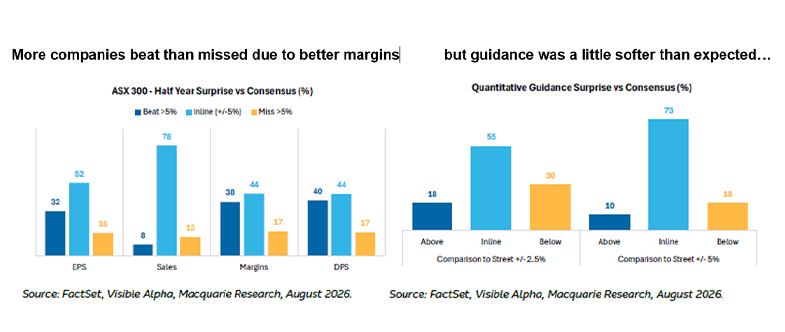
The August reporting season in Australia was better than feared but not as strong as the headline numbers suggest. Companies broadly exceeded downgraded expectations, driven primarily by margin resilience, cost control and stronger resource earnings, rather than robust revenue growth. The key message from results was that the Australian economy is becoming increasingly bifurcated, with consumer and housing activity slowing, while AI-related investment, infrastructure, defence and mining activity remain strong. Volatility was once again high, while M&A increased.
Key stats included:
- Revenue outcomes were broadly in-line with expectations (~80% of companies met forecasts).
- Net profit / Earnings beats outnumber misses by ~2:1 with a high number meeting expectations.
- Dividend outcomes were even stronger with ~43% of companies delivering dividends ahead of expectations and only 12% below.
- However, analysts generally remained cautious, with consensus downgrading FY27 earnings estimates for roughly three companies for every two upgraded.
- Winner and Losers:
- Winning sectors included: Healthcare, Materials, AI enablers. Healthcare rallied strongly supported by an earnings recovery and absence of material guidance misses which have weighed on recent reporting periods for the sector. AI infrastructure and electrification remains a key theme and Resources benefiting from AI-related commodity demand
- Sectors with deteriorating fundamentals included: Banks (softer credit growth, increased competition, risk of higher bad debts), Consumer discretionary (outlook for housing related retailers particularly weak) and Real Estate (suffering under a rising rate environment). A weakening consumer and housing cycle along with persistently restrictive interest-rate settings soured the outlook for domestic economy facing businesses.
Key themes included:
- Earnings growth was strong, but Resources did the heavy lifting - FY26 ASX200 earnings growth settled around 12%, well above the long-term average. However, much of that growth came from the resources sector, buoyed by stronger commodity prices and AI-related demand for mining commodities. Ex-resources earnings growth was much more modest at around 5%
- Margins beat - The major surprise of the season was margin resilience. Sales generally remained subdued, especially among consumer-facing businesses.Many companies delivered earnings beats despite soft revenue growth through cost reduction programs, productivity improvements, better product mix and lower-than-feared cost inflation.
- Inflation remains sticky which may mean rates remain higher for longer - Despite weaker consumer demand, inflation pressures remain evident in labour costs (typically 4-5% wage inflation), insurance claims, construction costs, energy and transport costs and technology infrastructure costs associated with AI deployment.
- Although reporting season delivered more earnings beats than misses, the outlook became more cautious:
- FY27 ASX200 earnings growth expectations have been reduced to roughly 9%.
- Consensus earnings estimates have been steadily downgraded since March.
- Consumer-facing sectors remain vulnerable to restrictive monetary policy and slowing housing activity.
- The strongest earnings momentum remains concentrated in healthcare, AI infrastructure, mining services and selected industrials
Q2 Reporting season in the US and Europe was also strong. Key points included:
- There was a positive earnings surprise seen in all regions and a solid breadth of beats
- Earnings growth of ~25% y/y and ~23% y/y in the US and Europe, respectively, was better than consensus expectations. Top-line growth was healthy too, at ~14% y/y in the US and ~10% y/y in Europe.
- US earnings per share forecasts rose despite already elevated expectations
- At a sector level, a large share of the earnings growth in both regions is being driven by the Energy sector, which was helped by the conflict-driven rise in energy prices. Financials were a notable driver of earnings in both regions too, as well as Tech.
- US companies provided positive earnings guidance relative to expectations
- Despite a solid earnings season, the stock-price reaction has been relatively muted likely reflecting a combination of elevated expectations, crowded investor positioning in the sector, and an increased focus on capex commentary.
Find out more about Asset Management
DOWNLOAD FULL REPORT