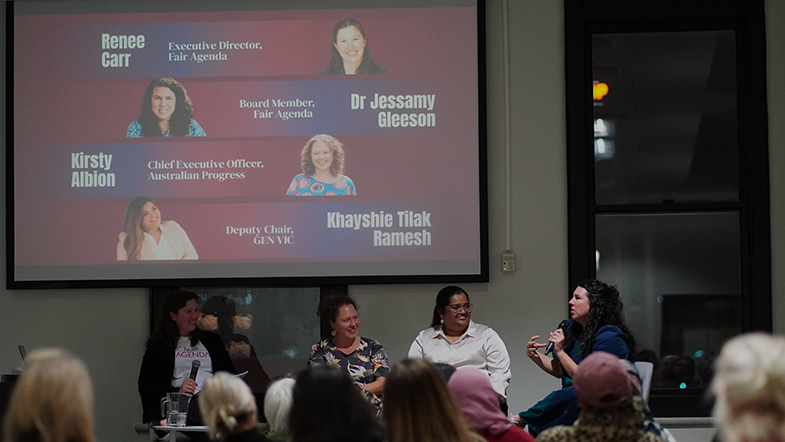
Women Deliver conference united voices for gender equality in Melbourne
The Women Deliver Conference brought global voices to Melbourne to talk about progress, challenges and opportunities for gender equality. Discussions highlighted growing debate over the future of gender equality reforms and the forces shaping them.
Gender equality is about making sure people of all genders can access the same rights, opportunities and safety.
For decades, advocates and leaders across communities, business, parliament and the media have worked to build public support for change, helping to reshape systems, laws and practices. Their collective efforts have delivered important gains in women's reproductive healthcare, representation in leadership, workplace rights and protections, and the recognition and prevention of domestic and sexual violence.
These changes have been hard won. But according to gender equality advocates like the non-profit, Fair Agenda, they are not guaranteed or permanent. Renee Carr, Executive Director and co-founder of Fair Agenda explains that in several countries, shifts toward more authoritarian forms of decision-making are placing pressure on some of these advances. “We need to remain aware that progress towards gender equality needs, not just to be achieved, but also protected,” says Renee.
A global conversation on our doorstep
Melbourne recently hosted the Women Deliver Conference, one of the world’s largest gatherings focused on gender equality. It was the first time this global convening has been held in Australia.
The conference brought together 6,000 delegates from 189 countries, including global political leaders, activists and advocates working across gender equality and human rights. Former Australian Prime Minister Julia Gillard, former Canadian Prime Minister Justin Trudeau, and former New Zealand Prime Ministers Helen Clark and Jacinda Ardern were all in attendance.
Discussions at the conference examined the rise of ‘anti-rights’ movements globally. Renee, who was at the conference, says these movements, that operate in opposition to human rights and gender equality frameworks, “often work by deliberately creating division, singling out particular groups and issues to spark fear, backlash or moral panic”.
“Rather than engaging in good faith policy debate, these groups’ efforts focus on reshaping public narratives, and positioning gender equality and human rights as controversial or threatening,” says Renee. “This kind of polarisation serves a higher purpose of making it easier to weaken public support for existing protections and stall further progress.”
Renee explains that this agenda is showing up internationally across campaigns to restrict, roll back or block reform regarding access to terminations, sexual health education and marriage equality. It has also challenged protections for transgender people and reinforced more traditional, male-dominated gender roles.
“This is where the role of funders becomes critical. Anti-rights movements are not under-resourced. They are coordinated, strategic and backed by significant funding.”
Why this should matter to all Australians
Renee reflects that Australia has made real progress towards gender equality in recent years, but much of it is recent and still evolving. However, she believes many of the rights now taken for granted were only secured very recently. “For example, Australia only achieved nationwide decriminalisation of patient access to abortion in 2024.”
That is why Fair Agenda is supported through funding from Equity Trustees’ Equity and Empowerment program. Equity Trustees’ Equity and Empowerment program aims to fund better futures for organisations that are challenging various types of disadvantage, like gender inequity.
Fair Agenda is also working in collaboration with International Women’s Development Agency (IWDA), Equality Australia, and International Planned Parenthood Federation, Australia and New Zealand Office (IPPF) to respond to the growing global anti-rights movement in Australia.
Founded in 2013, Fair Agenda is a national movement advocating across gender equity issues, and working for a future where we can all live with safety, security and agency over our lives.
“The conference served as a reminder that we all have to be doing all we can to prevent the rights that so many fought so hard for from being eroded,” says Renee.
“Thousands of delegates came together at the conference to bring awareness to what anti-rights groups are doing to undermine human rights, particularly for women, girls and gender diverse people. There’s [FH1] an informal international network of groups pushing this agenda; that is connected; and incredibly well-funded to try and hijack public debate and policy. These groups’ backers have funnelled more than $6 billion over 10 years into these kinds of efforts globally,”* she says, citing research by the Global Philanthropy Project.
Renee states that despite the widespread nature of the anti-rights movement, many Australians remain unaware of their national progress or impact.
“This is where the role of funders becomes critical. Anti-rights movements are not under-resourced. They are coordinated, strategic and backed by significant funding. By comparison, many of the organisations working to protect and advance gender equality, such as Fair Agenda, are operating with far fewer resources.”
“Philanthropic funding for organisations such as Fair Agenda supports the ongoing protection of rights earned to advance gender equality and other human rights.”
Fair Agenda has called for gender equity advocacy funding to keep pace with the speed and influence of the anti-rights movement, so that the voices of women can be heard.
“If funding doesn’t keep up, the consequence will not be neutral,” Renee says. “It could be an erosion of rights that have taken decades to secure, and as the global leaders in attendance at the Women Deliver conference warned, it is being driven at an alarming rate."
Find out more about Equity Trustees Philanthropy and Grant Funding
*Source: Global Philanthropy Project, Understanding the Resourcing of the Global "Anti-Gender Ideology" Movement (2020).
Photo: Speakers at a recent Fair Agenda event sharing insights from the Women Deliver conference. L to R: Renee Carr (Fair Agenda); Kirsty Albion (Australian Progress); Khayshie Tilak Ramesh (GEN VIC); Dr Jessamy Gleeson (Fair Agenda).